
In this article
- What people mean by a narcissistic parent
- Childhood signs you recognize as an adult
- Signs it still affects you today
- What it sounds like in a text
- Why limits are so hard with the person who raised you
- What you do not have to do
- When it shows up in your adult life
- When they get older and you are expected to care for them
- Keep a quiet record
- When it is more than a difficult relationship
- Sentences for when the guilt shows up
- A small step for today
- Frequently asked questions
Part of Recovery After Manipulation: Guides & Next Steps
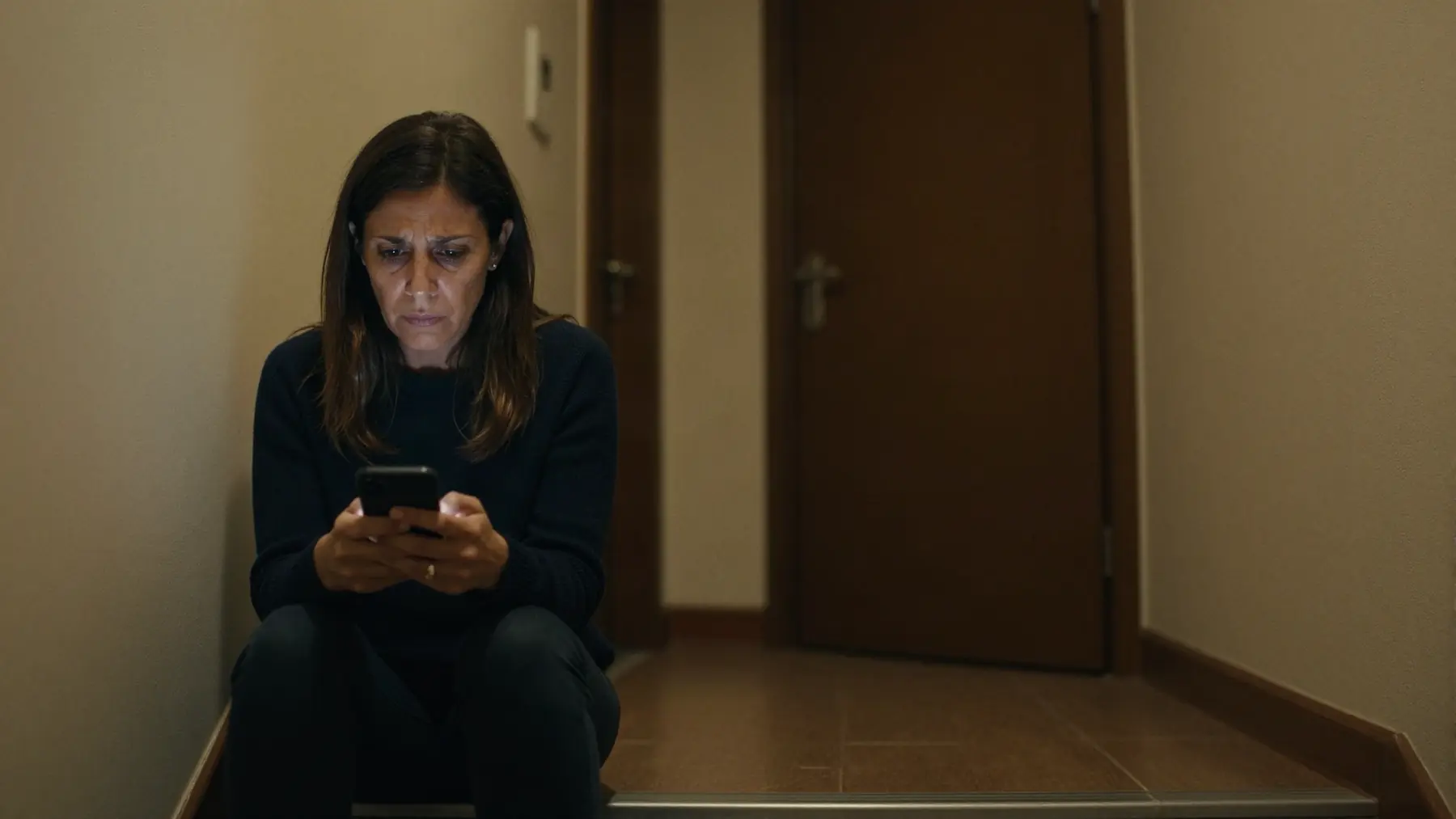
It is Sunday and your mother is calling. Before you even pick up, your shoulders have crept up toward your ears. You are thirty, or forty, or fifty, and you are still rehearsing answers so she will not take offense. If you have found yourself searching "narcissistic mother" or "narcissistic father" late at night, you were probably not looking for a diagnosis. You were looking for permission: permission to admit that something in that relationship hurts, even if from the outside it looks like a perfectly normal family. This guide gives you that permission, and a little order for what you feel.

What people mean by a narcissistic parent
When people talk about a narcissistic mother or father, they usually describe someone who needs admiration, shows little empathy, and treats their children as an extension of themselves. Your achievements become theirs. Your mistakes stay yours. Your affection has to be available whenever they need it.
It helps to be careful with the label. Narcissistic personality disorder is a real clinical diagnosis. The Mayo Clinic describes it as a mental health condition involving an unreasonably high sense of one's own importance, a need for admiration and difficulty with other people's feelings, often with fragile self-esteem underneath. The American Psychiatric Association describes personality disorders in general as ways of thinking, feeling and behaving that deviate from what a culture expects and cause distress or problems. Only a professional can make that diagnosis, after an assessment, and nobody can do it from the outside. You do not need it either.
What matters for you is simpler. You grew up in a home where love depended on being useful, impressive or quiet, and that left marks. You can love your parent, be grateful for real things they did, and still recognize that they hurt you. Both can be true at the same time.
The internet also has names for the roles children take on in these families: the "golden child", the "scapegoat", the "invisible child". These are popular terms, not clinical ones, and you do not have to fit any of them. Use them only if they help you put words to what happened.
Childhood signs you recognize as an adult
Many adults only see these patterns once they have some distance, a partner who grew up differently, or a child of their own.
Not all of them have to apply. Every family makes mistakes without being abusive. What gives you information is the repeated pattern, and how it left you feeling: smaller, on alert, or afraid of disappointing someone.
Signs it still affects you today
If several of these sound familiar, you are not exaggerating. You learned a way of relating that once protected you. Today you get to choose another one.
What it sounds like in a text
As adults, these patterns often travel by text message. Notice that almost every one of the examples below ends in the same place: you feeling that you owe something.
| Example message | What it is trying to do |
|---|---|
| "After everything I sacrificed for you, this is how you repay me." | Turn your limit into a debt. |
| "Your sister never talks to me like that." | Compare you so that you give in. It is a form of triangulation. |
| "I don't know why I bother. You never even call." | Make you feel guilty for having your own life. |
| "If you really loved me, you would come." | Measure love in obedience. |
| "That's not what happened. You always make things up." | Make you doubt your memory of your own childhood. |
| "You know how I am. Don't take it the wrong way, but..." | Say something hurtful and pre-empt your reaction. |
These are illustrative examples written by our editorial team from patterns described in the literature. A single message proves nothing, because everyone says something unfair now and then. What counts is the repetition, and that it always points in the same direction. Our guide to manipulative text messages decodes many more, and if you want a second reading of a real thread, the Conversation Analyzer can show which patterns appear and where.
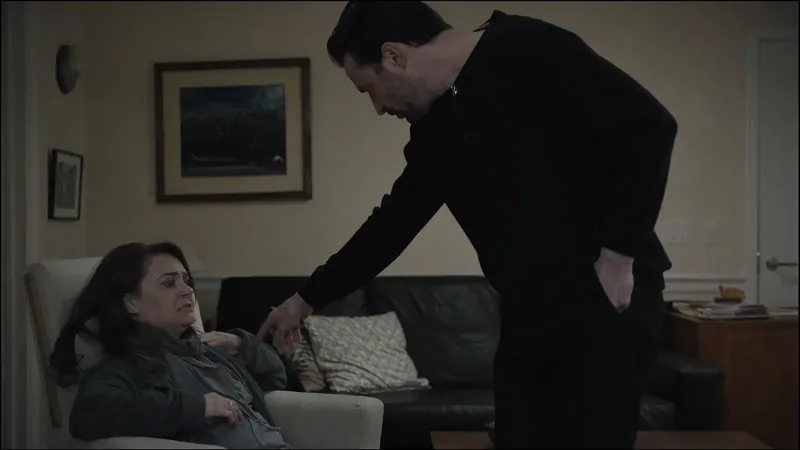
When you raise something that hurt and the reply is a flat denial, an attack on your character and then your parent presenting themselves as the injured one, you may be looking at the pattern described in our article on DARVO. It is especially common when adult children try to talk about their childhood.
You grew up in a home where love depended on being useful, impressive or quiet, and that left marks.
Why limits are so hard with the person who raised you
Because it is your family. Because they may also have cared for you in real ways. And because you learned very early that your parent's mood was your responsibility. A child cannot choose; a child adapts. That reflex does not switch off when you turn eighteen.
Sometimes warmth exists and arrives in a rush, often right after a crisis. That mix of hurt and relief is confusing, and it can make the bond feel stronger rather than weaker. It is the same mechanism we explain in trauma bonding, even though the bond here began in childhood.
There is also grief. Not for someone who has died, but for the parent you needed and did not get. It is a strange grief, because the person is still alive and may call you on Sunday. It is normal for it to hurt, and normal not to know where to put it.
What you do not have to do
You do not have to confront your parent to "clear the air". With someone who cannot admit mistakes, that conversation often ends in anger or self-pity, and with you exhausted. You do not have to forgive today. You do not have to cut contact if you do not want to, and you do not have to keep it at any price.
There is a wide middle ground between those extremes:
- Shorter calls, with a time limit you decide in advance
- Visits with a clear end time, ideally with your own way home
- Topics you simply do not discuss
- Brief, neutral replies to messages that try to pull you in
The grey rock method can help with the last one, and our guide on how to reply to a narcissist's text has wording that works just as well with a parent. Each person chooses their own point on that line, and it can change over the years.
When it shows up in your adult life
What we learn at home tends to repeat outside it. You may be the one who takes care of everyone at work, the friend who always listens, the partner who always adjusts. Or the opposite: you may keep everyone at arm's length, because closeness once meant being swallowed.
If you have children, it can be frightening to hear your parent's words come out of your own mouth. That fear is a good sign. It means you want to do it differently, and noticing the pattern is the first step. The rest is practice and, if you can, support.
When they get older and you are expected to care for them
At some point many adult children face a parent who needs help, while everyone in the family looks at them. You may feel obligation, guilt, and a mix of tenderness and anger all at once. That is normal.
There are options between doing everything and doing nothing. You can organize care without providing all of it yourself, share tasks with siblings, bring in outside help, and set limits on how often and how long you visit. Caring for someone does not mean accepting mistreatment from them, and deciding how much you give is your decision.
Keep a quiet record
If conversations with your parent leave you doubting your own memory, writing things down helps. The National Domestic Violence Hotline notes that documenting abuse can help people process complicated emotions and can serve as evidence if it is ever needed, and it suggests keeping records somewhere the other person cannot find them. A few dated lines after a hard call are enough: what was said, what you felt, what happened next.
You are not building a case. You are giving your future self something solid to hold when someone insists it never happened.
If conversations with your parent leave you doubting your own memory, writing things down helps.
When it is more than a difficult relationship
The Hotline describes emotional abuse as non-physical behavior meant to control, isolate or frighten someone, and notes that it is often subtle and hard to identify but just as serious as other kinds of abuse. Some parent relationships cross that line, at any age. If you are afraid of a parent, if they threaten you, control your money, or turn up where you live or work uninvited, that is a safety question, not just a family one. Talk to a support line or a counselor about your options, and in an emergency call your local emergency number.
Sentences for when the guilt shows up
- "I can love my mother or father and still set a limit."
- "Their anger is not my responsibility."
- "I do not have to prove I am doing it right to deserve respect."
- "Saying no does not make me a bad daughter or a bad son."
- "My childhood was real, even if others remember it differently."
Pick the one that fits best and repeat it when guilt knocks. At first it will sound false. With time it becomes yours.
A small step for today
Choose one small limit and try it this week. Do not answer the call the moment it rings; call back when you are ready. Or open the call with "I have ten minutes." Or make a decision without explaining or justifying it. It does not have to be brave. It only has to be yours.
Write one sentence and keep it where you will see it: "My worth does not depend on whether they are happy." Read it before each call. A change that seems tiny can change a lot over time.
Talking to a licensed therapist who understands family dynamics can help a great deal. It is a place to be believed. If you are thinking about harming yourself, in the United States you can call or text 988, and elsewhere your local crisis line.
You may have spent years taking care of the person who was supposed to take care of you. That was not your fault. You were not a difficult child or an ungrateful one. You were someone doing what you could in a place where love came with a price. Today you do not have to solve everything. It is enough to start treating yourself the way you wished you had been treated.
Frequently asked questions
How do I know if my mother or father is a narcissist?
You cannot know for certain, and you do not need to. Only a professional can diagnose a personality disorder after an assessment. What you can observe is the pattern: conditional affection, little empathy, guilt, and outsized reactions whenever you question them. What matters most is how it affected you.
Is it normal to feel guilty when I set limits?
Yes. You learned that your parent's discomfort was your job to fix, so guilt shows up even when the limit is fair. Feeling guilty does not mean you are doing something wrong. It usually means you are doing something new.
Do I have to go no contact?
Not necessarily. There is a whole range between keeping everything the same and cutting contact: shorter calls, fewer visits, topics you do not discuss, brief replies. If there is violence or a risk to you, safety comes first.
Can I love someone who hurt me?
Yes. Love and hurt can exist side by side. Recognizing the hurt does not erase the love, and the love does not cancel the hurt.
What if my siblings do not see it the same way?
That happens often. Each child can have a very different relationship with the same parent, especially if they were given different roles in the family. Their experience does not cancel yours.
Sources
- American Psychiatric Association. What are personality disorders? psychiatry.org/patients-families/personality-disorders/what-are-personality-disorders
- Mayo Clinic Staff. Narcissistic personality disorder: Symptoms and causes. mayoclinic.org/diseases-conditions/narcissistic-personality-disorder/symptoms-causes/syc-20366662
- National Domestic Violence Hotline. Types of abuse. thehotline.org/resources/types-of-abuse
- National Domestic Violence Hotline. Documenting abuse. thehotline.org/resources/documenting-abuse
Share this article
Paste your conversation, first finding free
The analyzer points to the exact message, names the pattern and tells you how sure it is. It is a way to organize what you see, not a diagnosis.
Free checklist
14 Manipulation Tactics: A Checklist (PDF)
A 7-page printable checklist: what each pattern looks like, what you might notice and what can help. Enter your email and the download link appears here. You will also get the weekly Narclyze note, and you can unsubscribe at any time.
By subscribing you agree to receive the weekly Narclyze note. See our Privacy Policy.
Keep reading
 Manipulation tacticsHow to Respond to DARVO: 4 Steps + Examples
 RecoveryTrauma Bonding: Signs, Causes & How to Break It
 RecoveryHow to Reply to a Narcissist's Text: What to Say and What to Skip
More reading: Grey Rock Method Examples: What to Text (Scripts)